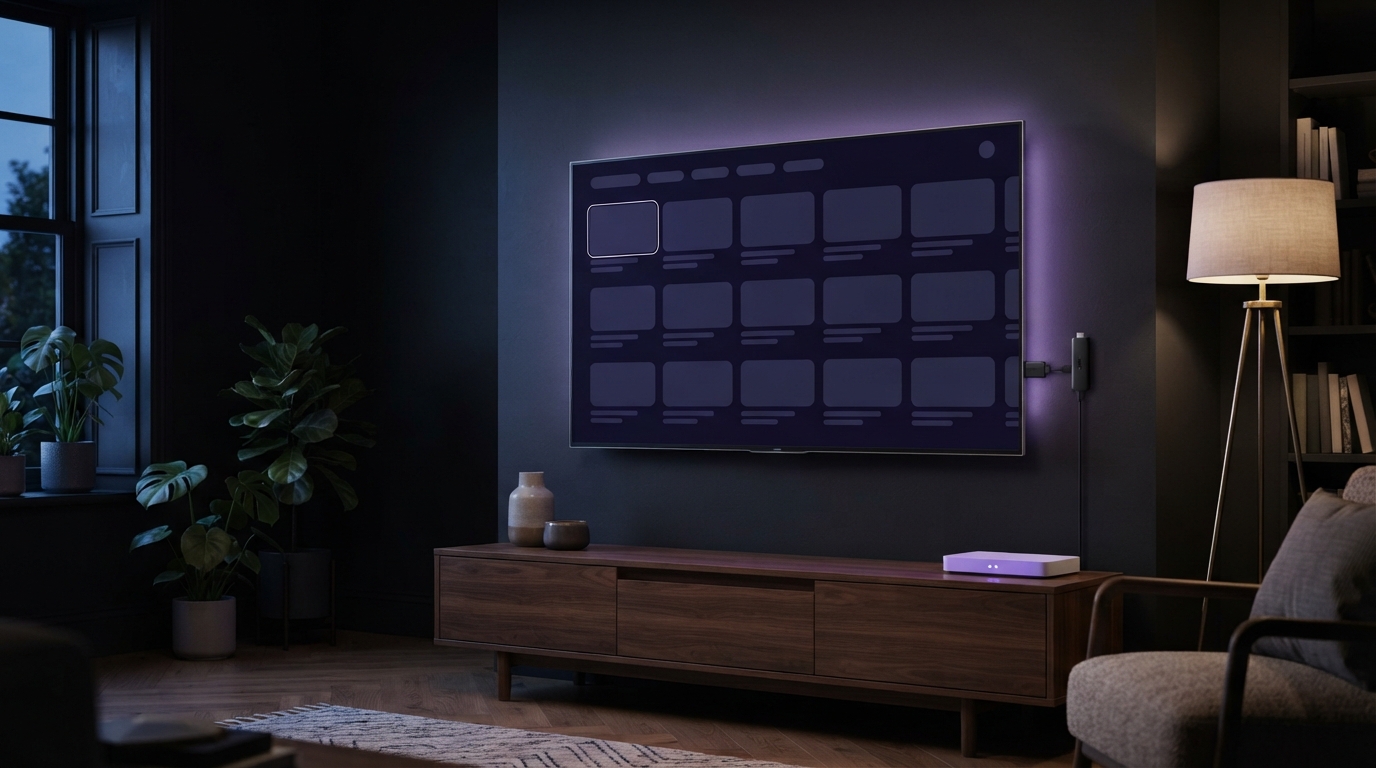
An IPTV box is television delivered over your home internet connection instead of a
dish, an antenna or a cable. You pay a provider, you get a login or a playlist line,
you put it into an app on a Fire Stick or a smart TV, and the channels turn up. An IPTV
subscription in Canada runs roughly $6.67 to $19.99 CAD a month depending on how long you buy
for. The technology itself is legal; what decides whether a specific service is legal is
whether the content on it is licensed. Everything below is the detail.
Every few years Canadian television invents a new way to charge you $120 a month, and every few
years somebody works out you can just use the internet. That is IPTV. Internet Protocol
Television, the TV arriving down the same line as everything else in the house, with no dish on
the balcony and no technician giving you a four-hour window on a Thursday.
The mechanics are dull, which is a good sign. A provider runs servers carrying live channel
streams and an on-demand library. You get credentials or a playlist line. You put those into a
player app on hardware you already own. Press a channel, the app pulls the stream, the picture
arrives. That is the whole technology. Everything genuinely interesting about buying an IPTV
box in Canada is about price, licensing, and whether your router is up to it.
Why the Canadian IPTV market looks the way it does
The problem was never the price of one subscription. It is that there are four. Hockey sits with
one broadcaster, the other North American leagues with another, international football moves
around depending on the year, and the premium film tier is a separate line on a separate bill.
Add a per-language international package, the normal case in most Canadian cities, and a
rented box on top, and nobody designed the result. It is what happens when rights get sold in
packages and viewers get sold nothing.
So the average household ends up on a cable bundle somewhere between $100 and $150 a month,
watching about six channels of it, and losing the promotional rate the moment the intro deal
ends. Then the box rental, $15 to $25 a month for equipment you never own and have to return
in person, quietly outlives every other line on the bill. That is not inflation. That is a
business model.
IPTV
grew in that gap. One line item instead of four, no dish, and the decent providers do not keep
your card. The bad ones are somebody in a local classifieds ad or a community group who takes
$60 for a year and blocks you in week three. Most of this guide is about telling those two
apart.
Seven checks before you pay any IPTV provider in Canada
Run a candidate through these in order. Most services fail on one of the first three, which
saves you reading the rest.
1
A price you can see all of, including month 13
The number on the page should be the number that leaves your account, in Canadian dollars, and there should be a second number telling you what renewal costs. If renewal is not written down anywhere, someone made that decision on purpose. Ours is a one-off payment: $19.99 CAD for a month, $79.99 CAD for twelve. No card is kept on file, so nothing renews itself while you are asleep.
2
A way out in the first week
A 7-day money-back window is the cheapest honesty test there is. It costs a provider nothing if the service works, and quite a lot if it does not. Ask for it in writing before you pay. If the answer is a paragraph about refunds being handled case by case, you already have your answer.
3
An honest number of devices
"Unlimited devices" is a warning, not a feature. Bandwidth is finite and somebody is paying for it. A provider selling unlimited is either overselling capacity or has not thought about it, and you find out which at 3pm on a Saturday. Our default is restricted to one device. If you have multiple devices, say the telly downstairs and the bedroom, we do offer a multi-device plan, sorted over WhatsApp.
4
Support that is awake during the ninety minutes
The whole job is the game. Support that closes at 5pm on a Friday is support that does not exist. Test it before you pay: message them at nine thirty on a Saturday night and time the reply. Ours runs 24/7 on WhatsApp, which in a country spanning six time zones is the only support model that actually works.
5
Capacity pointed at Canada, not a flag on a list
Plenty of services advertise a Canadian section that turns out to be a handful of channels routed from another continent. You can spot it in ten minutes. Open a Canadian channel at peak time, then open the same one at four in the morning. If four in the morning is flawless and peak time stutters, that is contention on their route, not your router. The same test exposes a thin French-language lineup, which matters if you are buying IPTV in Ontario for a bilingual household.
6
Apps for the hardware already in your house
Check the list before you buy, not after. Smart TV, Fire Stick, Android phones, tablets and boxes, iOS, MAG, Apple TV, Windows, Mac, Nvidia Shield, Enigma2 and Formuler are the ones that matter here. If a provider supports exactly one obscure player app, you are buying their app, not their service. Our player app comparison goes through the main ones.
7
A payment method that leaves a paper trail
Bank transfer, debit or credit card, Apple Pay, Google Pay and crypto all leave a record you can point at later. A seller who takes exactly one untraceable method is telling you what happens when it stops working. That is not a moral judgement, it is a practical one. You want a receipt.
What an IPTV box actually costs in Canada
Honest numbers, in Canadian dollars. Every plan below is a one-off payment, tax
included. No card is kept on file and nothing auto-renews, which means the only way you
pay us twice is if you decide to.
Plan
One-off price
Effective per month
Saving vs monthly
1 month
$19.99 CAD
$19.99
-
3 months
$39.99 CAD
$13.33
$19.98
6 months
$59.99 CAD
$10.00
$59.95
12 months
$79.99 CAD
$6.67
$159.89
The 12-month plan includes a premium IPTV player app, which is $14.99 CAD bought on its own. All
four plans carry the same catalogue: 50,000+ live channels across 50+ countries, 200,000+
on-demand films and series, in 4K, FHD and HD where the source supports it. There are no tiers,
so the French-language lineup and the international channels are in the $19.99 CAD plan rather
than sold as add-ons.
The most common message the support desk gets from a new customer is a screenshot of the cable
bill they have just cancelled. It is nearly always between $100 and $150. They kept it for three
things: hockey, the premium film tier, and one language package for a parent. They are now on
$6.67 a month with all three, plus another 49,000 channels they will never open. (I have yet to
meet anyone who has voluntarily opened the international news bouquet. It is there. It is
lovely. Nobody goes.)
Is an IPTV box legal in Canada? Where the line actually sits
IPTV is a delivery method, and delivery methods are not illegal. The free catch-up apps on your
TV are IPTV. So are the big subscription streaming services. So is most of what a modern smart
TV does when you press any button at all. Owning the hardware, whether a Fire Stick, a Formuler unit or an
Android box, is not a legal question at all.
Licensing is what decides it. A service is legal when the content it carries is
licensed from whoever owns it, and it is not when that content is being redistributed without
permission. The
Copyright Act
governs that, and the
CRTC
regulates broadcasting undertakings under the Broadcasting Act. Neither has a problem with the
protocol. Worth knowing too: Canada has no TV licence fee, so there is no separate household
payment to worry about the way there is in the UK.
The practical version for a buyer: a provider who will not tell you what they are licensed to
carry has told you something. We do not sell what is not ours to sell. No wink, no grey area, no
"don't worry about it." If a channel is not on the list, it is not on the list. There is a
fuller breakdown in our guide to whether IPTV is legal in Canada.
What speed you need, and why your internet breaks first
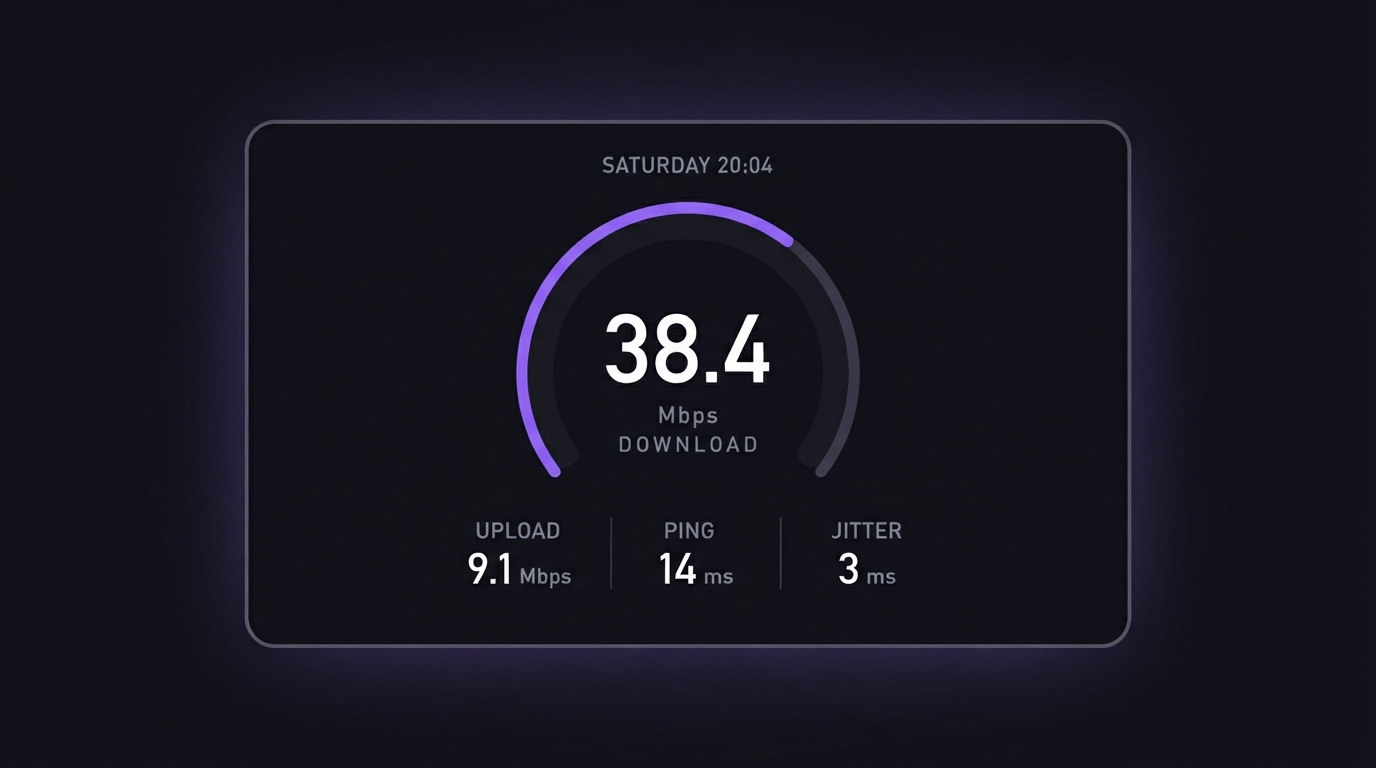
15 Mbps is the floor for reliable playback on a single HD stream. 4K wants around 25 Mbps, and
every additional simultaneous stream stacks on top of that. That is the entire requirement, and
almost every Canadian home plan clears it on paper.
On paper is doing a lot of work in that sentence. Test your speed at 8pm on a Saturday, not 11am
on a Tuesday. Your neighbourhood shares capacity, and the number that matters is the one during
the third period, not the one printed on your bill. The two connections that genuinely struggle
are rural fixed wireless under evening contention and satellite internet with a monthly data cap,
because live TV and a data cap are a bad match and no provider can engineer around it.
Nine out of ten "the IPTV is buffering" messages the support desk gets are not the IPTV. They
are a Fire Stick sitting three rooms from the router, sipping 6 Mbps of Wi-Fi through a wall
somebody framed in 1974. In rough order of how much difference they make:
Run an ethernet cable. A $10 cable beats an $80 router upgrade and it is not close
If you cannot cable it, get on the 5 GHz band rather than 2.4 GHz. Most routers broadcast both and most people are on the wrong one. In a downtown condo tower this is the single biggest fix, because every unit on your floor is crowding the same 2.4 GHz channels
Restart the router, not the box. Everyone restarts the box. The router has been up for 340 days and is the actual problem
Use the little HDMI extender that came in the Fire Stick box, especially behind a wall-mounted TV. Most people throw it out
For an older Montreal plex or a Toronto semi with plaster over lath, powerline adapters are the honest answer today. Mesh is better if you are buying new
Devices, apps and the fifteen-minute Fire Stick setup
The service runs on smart TVs, Fire Sticks, Android phones, tablets and boxes, iOS devices, MAG
boxes, Apple TV, Windows, Mac, Nvidia Shield, Enigma2 receivers and Formuler boxes. If it has a
screen and a network stack, it is probably on the list. Our
IPTV boxes guide ranks the hardware worth buying.
One warning. Do not buy the cheapest box on the marketplace. A $30 device ships with 1 GB of RAM
and a chipset from 2016. It works for two weeks, then stutters on anything at 60fps, which on a
hockey stream is every single second of it. Buy once.
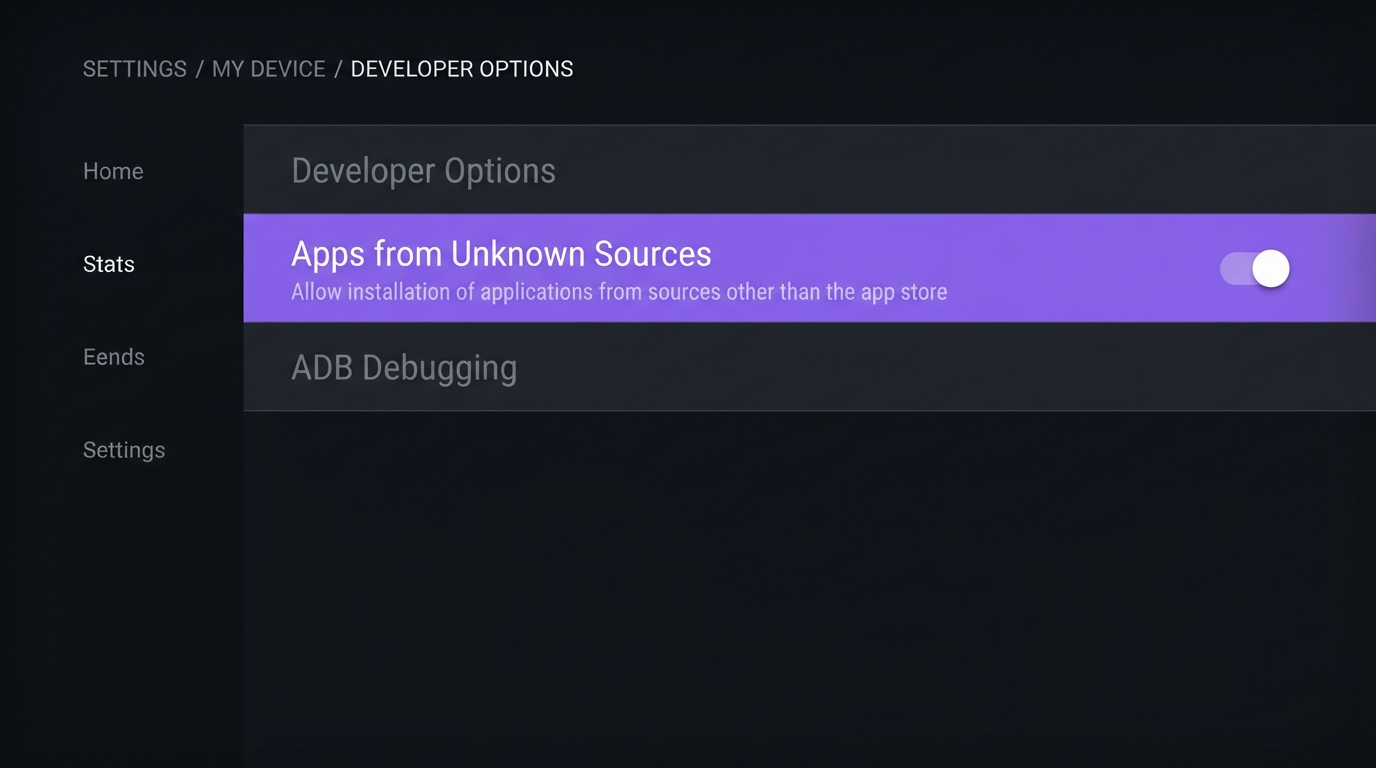
Fire Stick setup, which is the one most people need:
Settings, then My Fire TV, then Developer Options, then turn on apps from unknown sources. If Developer Options is missing, open About and click the device name seven times
Search the Fire TV store for Downloader and install it
Open Downloader and enter the address for the player app we send you
Install the player, open it, and paste in the playlist line or login details from your activation message
Let the channel list and guide load once, fully, before you start pressing things
Under 15 minutes, and support will sit on WhatsApp with you while you do it. A fair number of
the people we talk through this are retired, have never sideloaded anything in their lives, and
finish with the same sentence: that was easier than I thought. Full walkthroughs for every
device are on our installation guides page.
Do you need a VPN for IPTV in Canada
No. This comes up weekly and the honest answer has not changed. The service runs without one. A
VPN is worth having for privacy on shared or public connections, and it is fully compatible, but
the streams do not need it to work. Roughly half of Canadian customers run one and half do not,
and both halves get the same picture. The one Canada-specific reason to consider one is the
notice-and-notice regime, under which your ISP may forward you a rights-holder's letter. A
letter, not a fine.
Where a VPN does cause trouble is when it is stuck on a stale connection after your ISP has
rotated your IP. That looks exactly like the service being down, and it is fixed by toggling the
VPN off and on again. It has cost more than one person the opening fifteen minutes of a match.
The one-weekend test nobody tells you to run
Every comparison article on this subject will help you pick. Almost none of them tell you how to
check you picked right, which is odd, because it takes one weekend and it is the only evidence
that counts.
Friday night, off-peak. Open five channels you actually intend to watch and note how long each takes to start. Anything over four seconds is a routing problem, not a your-house problem
Saturday, 7pm to 10pm. The real test. Sit on one stream through a full game without touching anything. Buffering that only shows up here is contention, either in your neighbourhood or on their servers, and the Friday result tells you which
Saturday, 9.30pm. Message their support with a genuine question and time the reply. That number decides whether you are still a customer in a year
Do all of that inside the 7-day money-back window and you have bought a month, not a year, to
find out.
Which is the right way round.
When you should not buy IPTV at all
This section costs us money and it stays in.
You watch one game a month. Go to the bar. It is cheaper, the beer is better, and the argument afterwards is free
Your internet is under 15 Mbps at peak. Fix that first. No box has ever fixed a bad line, and the handful of 7-day refunds we do pay out are almost entirely this, usually rural fixed wireless or capped satellite. We would rather tell you on WhatsApp than take the money and send it back a week later
You only want the main Canadian broadcasters. An over-the-air antenna picks several of them up free in every major market. You do not need us
Nobody in the house will follow six setup steps. We will talk you through it, genuinely. But be honest with yourself about what your Saturday looks like
IPTV stands for Internet Protocol Television. It is television delivered over a broadband connection using the same internet protocols as everything else on your line, instead of over a satellite dish, an aerial or a cable. Live channels, catch-up and on-demand libraries all count.
How does IPTV work?
A provider runs servers carrying the channel streams. You get login details or a playlist line. You put those into a player app on a Fire Stick, smart TV, phone or box, and the app pulls the stream over your broadband when you press a channel. No hardware install, no engineer visit, no dish.
Is an IPTV box legal in Canada?
The technology is legal, and so is the hardware. The catch-up apps already on your TV are IPTV, and so are the big subscription streaming services. What decides legality is licensing: a service is legal when the content it carries is licensed from the rights holder, and it is not when that content is redistributed without permission. The Copyright Act governs that side, and the CRTC regulates broadcasting undertakings, but neither makes an IPTV box itself unlawful to own or use.
What internet speed do I need for IPTV in Canada?
15 Mbps stable is the minimum for reliable playback on a single HD stream. For 4K, or for more than one stream at once, budget 25 Mbps or more. Measure it at 8pm on a Saturday rather than 11am on a Tuesday, because your neighbourhood shares capacity and the number that matters is the one during the game. Effectively every urban Canadian home plan clears the floor; rural fixed wireless and capped satellite internet are the two that need checking first.
Do I need a VPN for IPTV?
No. The service runs without one. A VPN is worth having for privacy on shared or public connections and it is fully compatible, but the streams do not need it to work. Roughly half of Canadian customers run one and half do not, and both halves get the same picture.
How do I set up IPTV on a Fire Stick?
Turn on installs from unknown sources in Settings, install the Downloader app, use it to sideload the player app your provider recommends, then paste in the playlist line or login details from your activation message. It usually takes under 15 minutes, and support can stay on WhatsApp with you while you do it.
Is an IPTV box worth it in Canada?
It depends what you watch. If you are paying $100 to $150 a month for a cable bundle with a box rental, a sports tier and a language add-on, and using about six channels of it, the arithmetic is straightforward. If you watch one game a month, or you only want the main Canadian broadcasters, an over-the-air antenna picks those up free and you should buy that instead.
Do you cover IPTV in Ontario, and does the province change anything?
Searches for "iptv ontario", "ontario iptv" and "iptv ontario canada" all land on the same answer: IPTV in Ontario works exactly as it does anywhere else in the country, because delivery is over your existing internet connection rather than through a provincially licensed cable franchise. There is no separate Ontario IPTV product, no different channel list and no different price. A household in Ottawa, Hamilton, Windsor or Thunder Bay gets the same 50,000+ channels for the same $19.99 CAD as one in Vancouver. The only genuinely provincial difference in Canada is Quebec, where the French-language lineup does most of the work, and that lineup is in the standard plan here rather than sold as a tier. We run dedicated pages for IPTV in Toronto, Brampton and Ottawa because the local questions differ, whether that is condo Wi-Fi or per-language cable add-ons, rather than because the service does.
Do I need an IPTV box, or is a box optional?
Optional. The phrase "IPTV a box" turns up a lot in searches and it points at a real confusion: people assume IPTV requires buying a specific piece of hardware the way cable required a rented receiver. It does not. Any device you already own with a screen and a network connection will run it: a Fire Stick, a Smart TV, a phone, a laptop, an Android box. A dedicated box like a Formuler or a MAG gives you a more polished channel guide and a traditional TV remote, which is worth having if you watch several hours a day, but it is an upgrade rather than a requirement.
Is there an IPTV service near me, or does location matter?
Location does not matter the way it does with cable. Searching for IPTV near me is a habit carried over from services that need a technician and a franchise area. This one is delivered entirely over your existing internet connection, so a household in Thunder Bay gets the same channels, servers and price as one in downtown Toronto. There is no coverage map, no installation window and no local depot. We do run city pages for the largest markets, but only because the local questions differ, not the service.
Can I use it if I travel outside Canada?
Yes. The service works anywhere with a stable connection above 15 Mbps, which is why it is popular with snowbirds wintering in Florida and Arizona. A VPN set to a Canadian exit is occasionally useful abroad depending on the local network, but it is not a requirement.
The verdict
An IPTV box in Canada is a straightforward trade. You give up the dish, the rented receiver and
the technician visit, and you get one payment instead of four lines on a bundle with nothing
renewing behind your back. It works if your line clears 15 Mbps at peak and you are willing to
spend fifteen minutes with a Fire Stick and a player app. It does not work if your internet is
the problem, and any provider telling you otherwise is not worth $19.99 CAD.
Start on the month. Run the weekend test. If it holds up, the annual plan is $79.99 CAD and works
out at $6.67 a month, and if it does not, you have seven days to say so.
Message us on WhatsApp
Support runs 24/7, which in a country with six time zones is the only arrangement that
actually works, and it is the bit you will use most.
And if it is still stuttering after the cable, the 5 GHz switch and the router reboot, it is not
the box. It is the router your ISP mailed you in 2016, sitting behind a mirror in the hallway,
doing its best.
🇨🇦 $19.99 CAD · paid once
Get the Best IPTV Box in Canada Today
The best IPTV Canada plan we can build: 50,000+ channels, real 4K, top-flight sport and the full French-language lineup, live on your device in minutes. One payment, no contract, no auto-renewal, no hidden fees.